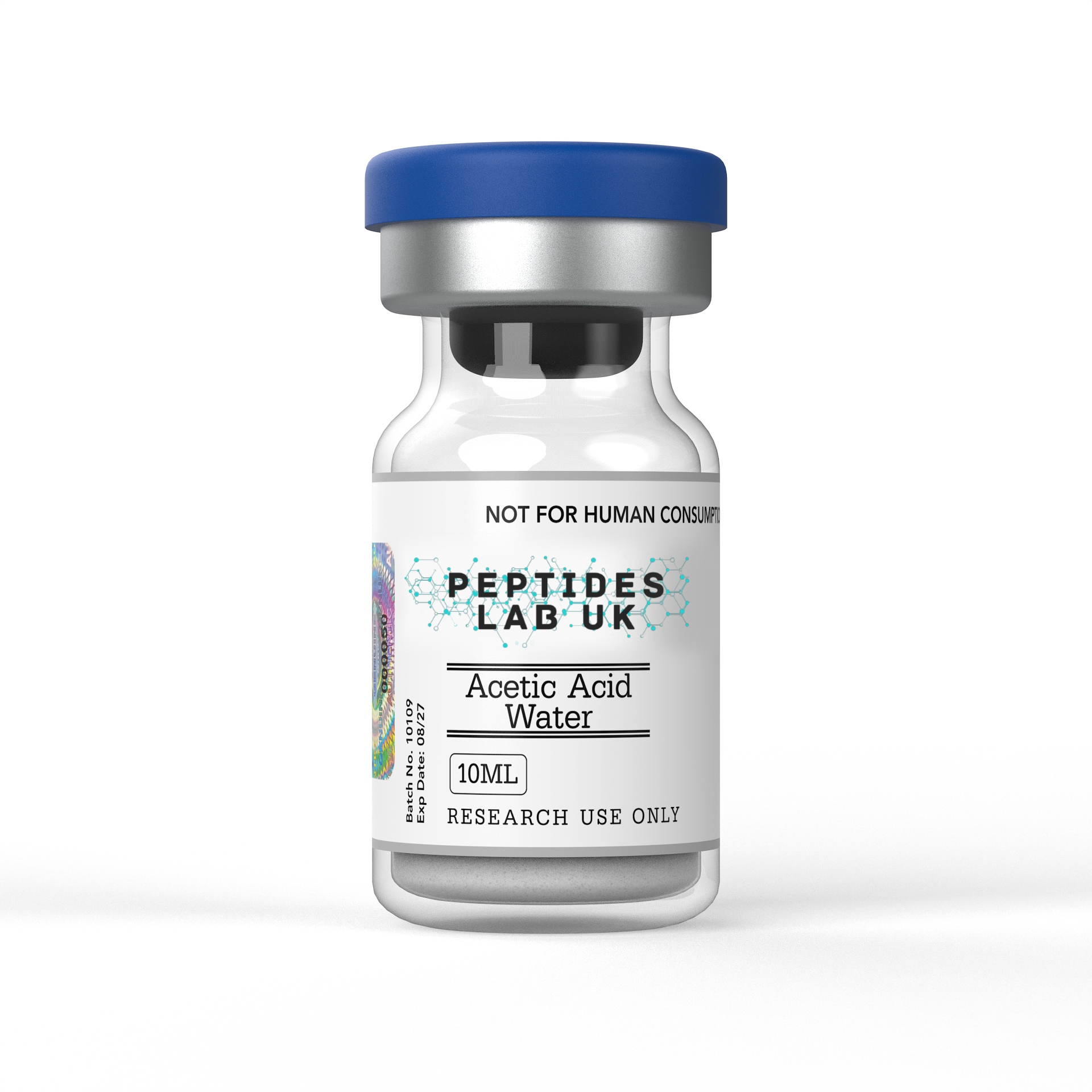
Acetic Acid Water For Lab Research
Price range: $7.99 through $11.99
Acetic Acid Water (0.1% acetic acid) is used to reconstitute research peptides such as IGF-1 and analogues in laboratory settings. For laboratory and in vitro research use only. Not for human consumption. Not a medicine.
Acetic Acid Water – Laboratory-Grade Peptide Reconstitution Solvent | Peptides Lab UK
Acetic Acid Water is a dilute aqueous solution of glacial acetic acid (typically 0.1–1% v/v), widely used in research laboratories as the preferred reconstitution solvent for lyophilised peptides that are insoluble or poorly soluble in water alone — supplied by Peptides Lab UK in a sterile, laboratory-grade format for in vitro and pre-clinical research use only.
Available to buy in the UK from Peptides Lab UK, acetic acid water is an essential laboratory reagent for researchers working with lyophilised peptide preparations. Many research peptides — including growth hormone-related peptides, IGF family peptides, and a range of neuropeptides — require an acidic aqueous environment for initial dissolution before further dilution into physiological buffers. Peptides Lab UK supplies acetic acid water as a sterile, ready-to-use reconstitution solvent, ensuring consistent and reliable peptide solubilisation across research protocols.
What is Acetic Acid Water?
Acetic acid water is a dilute solution of glacial acetic acid (CH3COOH) in sterile water, prepared at defined concentrations — most commonly 0.1% (approximately 17 mM) or 1% (approximately 170 mM) — for use as a peptide reconstitution vehicle in laboratory research settings. The slight acidity of the solution (pH approximately 3.0–4.0 at 0.1% concentration) protonates basic amino acid residues on poorly water-soluble peptides, increasing their net positive charge and improving electrostatic interaction with the surrounding aqueous solvent — a mechanism that dramatically increases the solubility of many lyophilised peptide preparations that resist dissolution in neutral or alkaline aqueous conditions.
In practice, acetic acid water is the recommended first-choice reconstitution solvent for a significant proportion of commercially available research peptides. Peptides with sequences rich in hydrophobic residues, or those with a high proportion of basic amino acids (lysine, arginine, histidine) that require protonation for charge-mediated aqueous solubilisation, typically reconstitute cleanly and completely in 0.1% acetic acid water — whereas the same peptides may form aggregates, gels, or turbid suspensions when reconstitution with neutral sterile water or bacteriostatic water is attempted first.
Once reconstituted in acetic acid water, research peptides are typically diluted into the appropriate physiological buffer, cell culture medium, or assay vehicle for experimental use. The small volume of acetic acid introduced at this stage is generally inconsequential at final working concentrations, but researchers should always confirm that the final assay pH and buffer conditions are appropriate for the specific experimental model being used.
Acetic Acid Water – Key Research Facts
- Composition: Dilute aqueous acetic acid (CH3COOH) — typically 0.1% or 1% v/v in sterile water
- pH: Approximately 3.0–4.0 at 0.1% concentration; approximately 2.4–2.8 at 1% concentration
- Primary function: Reconstitution solvent for lyophilised peptides with poor aqueous solubility at neutral pH
- Mechanism: Protonation of basic amino acid residues (Lys, Arg, His) increases net positive charge, improving aqueous solubilisation
- Best suited for: Peptides rich in hydrophobic residues, growth hormone-related peptides, IGF-1, IGF-2, GHRP-family peptides, and many neuropeptides
- Standard protocol: Reconstitute in acetic acid water first, then dilute to working concentration in physiological buffer or assay vehicle
- Format: Sterile, laboratory-grade solution supplied by Peptides Lab UK
- Storage: Store at room temperature or as directed; protect from contamination
What is Acetic Acid Water Used for in Peptide Research?
In the research laboratory, acetic acid water serves as a critical first-step solvent for peptide reconstitution workflows. Many of the most widely studied research peptides — including members of the growth hormone secretagogue family, IGF peptides, and a range of neuropeptides — are routinely reconstituted in 0.1% acetic acid water before further preparation steps.
The rationale for using acetic acid water rather than neutral sterile water or bacteriostatic water as the initial reconstitution solvent is well established in peptide chemistry. At neutral pH, peptides with hydrophobic sequences or isoelectric points near or above physiological pH tend to self-associate through hydrophobic interactions and hydrogen bonding — forming insoluble aggregates or gels that resist dissolution. The mild acid environment of 0.1% acetic acid protonates basic side chains, introducing electrostatic repulsion between peptide molecules and preventing aggregation, allowing the peptide to dissolve cleanly into a clear stock solution.
Once a clear stock solution has been prepared in acetic acid water, it is standard practice to perform subsequent dilutions into the intended experimental vehicle — for example, phosphate-buffered saline (PBS), cell culture medium, or another physiological buffer — to bring the working solution to the correct pH and ionic strength for the assay. This two-step reconstitution approach is documented as best practice in peptide reconstitution guidance from multiple research suppliers and peer-reviewed protocol literature.
Which Peptides Typically Require Acetic Acid Water for Reconstitution?
While reconstitution requirements vary by individual peptide sequence, charge, and hydrophobicity, acetic acid water is commonly the recommended or preferred first-step reconstitution solvent for the following categories of research peptides:
- Growth hormone-related peptides — including IGF-1, IGF-2, and related analogues
- GHRP family peptides — GHRP-2, GHRP-6, Ipamorelin, Hexarelin, and related growth hormone secretagogues
- Melanocortin peptides — including Melanotan I, Melanotan II, and PT-141 analogues
- Neuropeptides with hydrophobic core sequences
- Peptides with a high proportion of basic residues (Lys, Arg, His-rich sequences)
- Any lyophilised peptide that fails to dissolve cleanly in neutral sterile or bacteriostatic water
Acetic Acid Water vs. Bacteriostatic Water — Which to Use?
Bacteriostatic water (sterile water containing 0.9% benzyl alcohol as a preservative) is the recommended reconstitution solvent for peptides that dissolve readily at neutral pH — and its benzyl alcohol content provides antimicrobial protection during multi-use storage of reconstituted stock solutions. However, bacteriostatic water is not suitable as a first-step solvent for hydrophobic or basic peptides that require an acidic environment for initial dissolution.
The standard recommended approach for such peptides is to perform initial reconstitution in acetic acid water to produce a clear stock solution, then store the stock solution (if multi-use storage is required) by adding bacteriostatic water or PBS for further dilution. Researchers should consult the specific reconstitution guidance for each individual peptide — Peptides Lab UK provides product-specific reconstitution recommendations where applicable.
Acetic Acid Water UK – Specifications
Product Details
- Composition: Dilute acetic acid in sterile water (0.1% or 1% v/v as supplied)
- Grade: Laboratory / research grade
- Form: Sterile aqueous solution
- Storage: Store at room temperature; protect from contamination and direct sunlight
- Primary use: Reconstitution of lyophilised peptides for in vitro and pre-clinical research
- Distributed by: Peptides Lab UK
Research Applications
Suitable Laboratory Uses for Acetic Acid Water
- First-step reconstitution of lyophilised peptides with poor aqueous solubility at neutral pH
- Stock solution preparation for hydrophobic peptides, basic peptides, and growth hormone-related research compounds
- Two-step reconstitution workflows — acetic acid water first, then dilution into physiological buffer or assay vehicle
- Peptide solubility profiling — comparative dissolution studies across pH and solvent conditions
- Vehicle control preparations in in vitro peptide assay protocols
- Preparation of IGF, GHRP, melanocortin, and neuropeptide research stock solutions
Why Buy Acetic Acid Water in the UK from Peptides Lab UK?
Peptides Lab UK supplies acetic acid water as a sterile, laboratory-grade reconstitution solvent specifically formatted for use with lyophilised research peptide preparations. Sourcing your reconstitution solvents from the same trusted UK peptides supplier as your research compounds ensures consistent, verified quality across every component of your experimental workflow.
Whether you are reconstituting IGF-1, a GHRP-family peptide, a melanocortin analogue, or any other lyophilised peptide that requires an acidic first-step solvent, Peptides Lab UK’s acetic acid water provides a reliable, sterile, ready-to-use solution — eliminating the need to prepare and sterilise dilute acetic acid solutions in-house.
Related Search Terms
Researchers searching for: buy acetic acid water UK, acetic acid water peptide reconstitution UK, 0.1% acetic acid water UK, peptide solvent UK, reconstitution water UK peptides, acetic acid peptide water for sale UK, UK peptides research grade solvents, Peptides UK lab supply, peptide reconstitution solvent UK, buy acetic acid solution UK research, laboratory acetic acid water UK — Peptides Lab UK supplies this product for qualified laboratory researchers within the United Kingdom.
Important Notice & Research Disclaimer
⚠️ This product is supplied by Peptides Lab UK strictly for laboratory research use only. Acetic acid water as distributed by Peptides Lab UK is not intended for, and must not be used for, human consumption, medical treatment, self-administration, veterinary applications, or any use outside of a controlled laboratory environment. This product is handled exclusively in controlled research settings for in vitro and pre-clinical studies, with no applications in human or veterinary medicine.
Handling must only be performed by qualified and trained laboratory professionals in accordance with applicable regulations and institutional guidelines. Peptides Lab UK accepts no liability for any use of this product outside of its intended laboratory research purpose.
| Dosage | 10ml, 3ml |
|---|